
Comparing Binance and Coinbase reveals a major difference in cost structure.
1. Spot Trading Fees
| Exchange | Standard Spot Fee |
|---|---|
| Binance | 0.10% |
| Coinbase | 0.40% – 0.60% |
Binance is significantly cheaper for active traders.
2. Futures Trading
- Binance: 0.02% / 0.04%
- Coinbase: Limited derivatives availability

Coinbase is not built for high-leverage futures trading.
3. Deposit & Withdrawal Fees
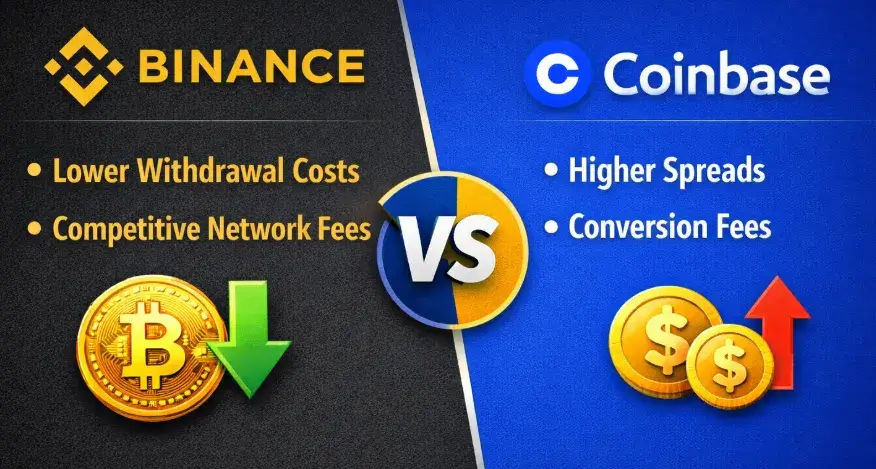
Coinbase often includes higher spreads and conversion fees.
Binance typically offers:
- Lower crypto withdrawal costs
- Competitive network fee structures
4. Interactive Binance Fee & Profit Calculator
Use this tool to estimate your trading costs and see how much you can save by using BNB discounts.
Binance Fee Estimator
Optimize your trading costs for 2026
*Real-time network gas fees and slippage are not included.
5. Security & Compliance
Coinbase is publicly listed in the US and is considered highly compliant.
Binance, while dominant globally, has dealt with regulatory disputes in several jurisdictions.
6. Who Should Choose Which?
- Cost-conscious active traders → Binance
- Futures traders → Binance\
- Beginners seeking simplicity → Coinbase

7. Additional Resources for You
🚀 Master Binance Trading with Hyukee.com
Master risk management with a professional breakdown of leverage and liquidation prevention.
Learn how to quickly flip your market position to capitalize on changing trends.
Stop losing money to fees. Discover the best strategies to optimize your trading costs.
💡 Editor’s Note: Maximizing Your Trading Setup
If you’re planning to start trading on Binance, using a partner referral link is the most effective way to reduce long-term costs. You can secure a 20% fee rebate applied directly to your account.
Apply 20% Discount to My Account →8. Frequently Asked Questions (FAQ)
Q1. Is Binance really cheaper than Coinbase in 2026?
Yes, in most cases Binance offers significantly lower trading fees compared to Coinbase.
Binance’s standard spot trading fee is 0.10%, while Coinbase typically charges between 0.40% and 0.60% depending on volume and region.
For active traders who execute multiple trades daily, this difference can have a meaningful impact on long-term profitability.
Q2. Does Coinbase have hidden fees?
Coinbase does not technically hide fees, but many users overlook the spread and conversion costs.
In addition to visible trading fees, Coinbase often includes a price spread during buy/sell execution, especially when using the basic interface. This can increase the total cost compared to exchanges like Binance that separate trading fees more transparently.
Q3. Which exchange is better for futures trading?
If your focus is futures or leveraged trading, Binance is clearly more suitable.
Binance offers competitive futures fees (0.02% maker / 0.04% taker) and high liquidity across many pairs.
Coinbase, on the other hand, provides very limited derivatives access and is not designed for aggressive leverage strategies.
Q4. Is Coinbase safer than Binance?
Coinbase is a publicly listed company in the United States and is widely regarded as highly compliant with US regulations.
Binance operates globally and has faced regulatory challenges in certain jurisdictions, but it remains one of the largest and most liquid exchanges in the world.
Security ultimately depends on:
- Your account protection settings (2FA, withdrawal whitelist, etc.)
- Proper risk management
- Storage strategy (exchange vs cold wallet)
Q5. Can I reduce Binance trading fees further?
Yes. Binance allows users to reduce fees through:
- Using BNB to pay trading fees
- Increasing trading volume tier
- Registering with a referral code
If you register using a referral code such as HYUK82, you may receive up to a 20% trading fee discount depending on the campaign terms.
For traders who plan long-term activity, even a small percentage reduction can compound into meaningful savings over time.
Q6. Which platform is better for beginners?
If simplicity and regulatory familiarity are your top priorities, Coinbase offers a very user-friendly interface.
However, if you are willing to learn basic trading tools and want lower costs, deeper liquidity, and futures access, Binance provides significantly more flexibility.
Q7. Does lower fee always mean better exchange?
Not necessarily.
Lower fees are important, but you should also consider:
- Liquidity
- Security history
- Regulatory stability
- Available trading pairs
- Withdrawal limits
Choosing an exchange should align with your trading style, experience level, and long-term strategy — not just headline fees.
9. Final Consideration
Before choosing between Binance and Coinbase, evaluate:
- Your trading frequency
- Whether you plan to use futures
- Your sensitivity to fees
- Regulatory comfort level
Cost efficiency matters, but sustainability and platform stability are equally important.
Always conduct your own research before making financial decisions.