
Bitcoin is currently under sustained selling pressure on the daily chart, and the price action is behaving exactly like a market that is trapped beneath major moving-average resistance while liquidity gets pulled lower.
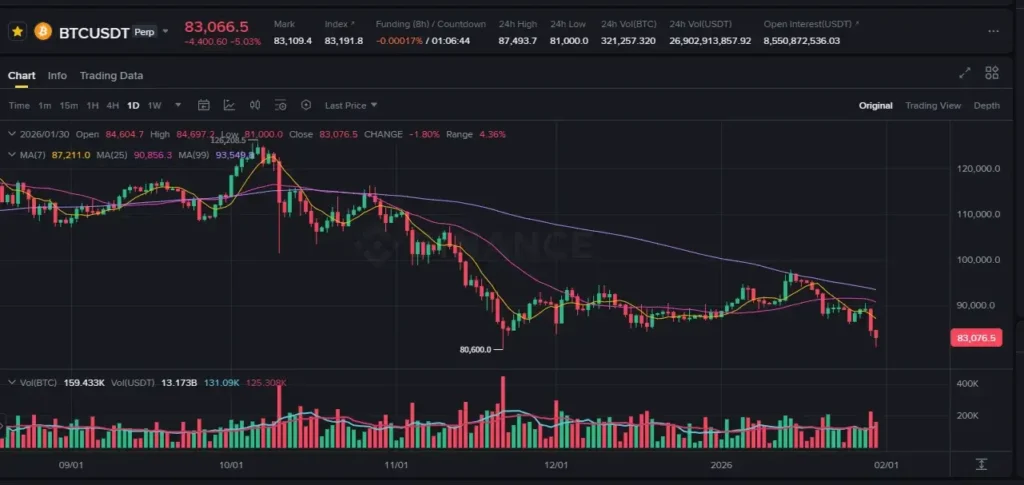
On your chart, BTC is trading around 83,076.5 (daily close shown near 83,076.5), down roughly -1.80% on the day, with the broader daily range around 4.36%. The bigger issue is not just “one red candle,” but the structure: lower highs, heavy overhead supply, and repeated failures to reclaim key trend filters.
Below is a deep, practical breakdown of what is driving the decline, what price levels matter most, what could happen next, and how to respond with a disciplined plan.
1. The Main Reason: Price Is Stuck Below Key Moving Averages (Trend Filter Problem)
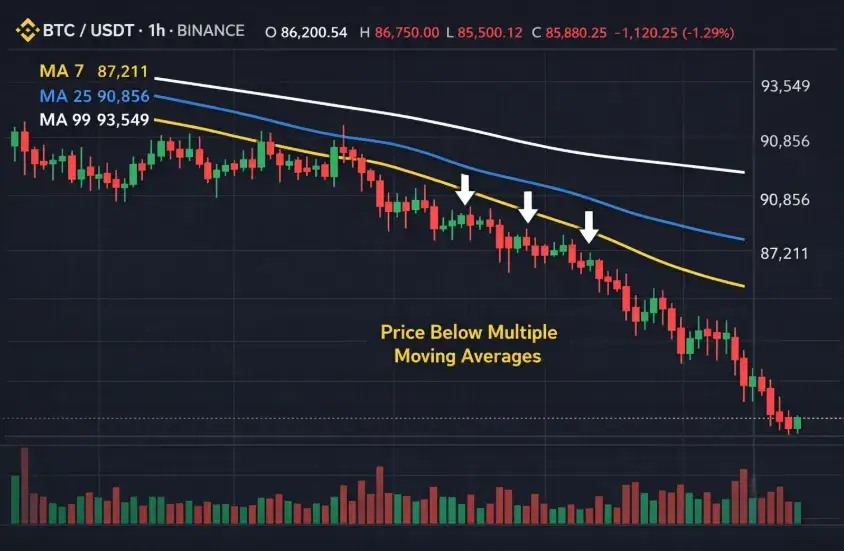
On the chart, Bitcoin is trading below the MA(7) ~ 87,211, MA(25) ~ 90,856, and MA(99) ~ 93,549. When price sits under multiple moving averages like this, those lines often act as dynamic resistance:
- Traders who bought higher use rallies into these averages to exit at better prices.
- Short-term bounces fail because the market still lacks strong follow-through demand.
- Each rejection encourages systematic and discretionary sellers to press again.
In simple terms: buyers are not strong enough to flip the trend filter back to bullish. Until BTC can reclaim and hold above at least the MA(25), rallies can remain “selling opportunities” rather than true reversals.
2. Liquidity Mechanics: Why Declines Can Feel “Automatic”
Bitcoin often falls in waves because of liquidity and positioning, not only news:
2-1. Stop-loss clustering
When support levels are obvious (round numbers, prior lows), stops accumulate beneath them. If price dips into that zone, it triggers:
- spot selling (panic exits)
- perpetual futures liquidations (forced selling)
- algorithmic momentum selling
2-2. Liquidation cascades
In leveraged markets, small drops can trigger liquidations, which become market sells, pushing price lower and triggering more liquidations. Even if there is no major headline, leverage can manufacture downside.
2-3. Funding and sentiment feedback loops
When sentiment turns bearish, traders reposition short, and every bounce gets sold faster. That keeps the market “heavy” until a clear catalyst or strong spot demand appears.
3. Macro and Risk Appetite: Bitcoin Is Still a “High Beta” Asset
Even with long-term adoption narratives, Bitcoin is still treated by many large allocators as a risk-on asset. That means it can slide when:
- real yields stay elevated
- the market expects tighter financial conditions
- global equities soften
- the dollar strengthens (often reduces risk appetite)
You do not need a dramatic macro headline every day for this to matter. The market can drift lower simply because capital becomes more selective and rotates away from volatility.
4. What the Chart Is Saying Right Now (Structure and Price Map)
Based on your daily chart:
Current price area
- ~83,066.5 (shown on the chart)
4-1. Key support zones (downside levels)
- 83,000 area (psychological + current pivot)
- If BTC keeps closing below this region, sellers typically test the next support quickly.
- 81,000 – 80,600 zone
- Your chart shows a notable low around 80,600.0.
- This is a critical area: a break and daily close below it can open the door to deeper downside.
- 80,000 round level
- Big psychological magnet. If liquidity hunts start, price often tags this zone even if it later rebounds.

4-2. Key resistance zones (upside levels)
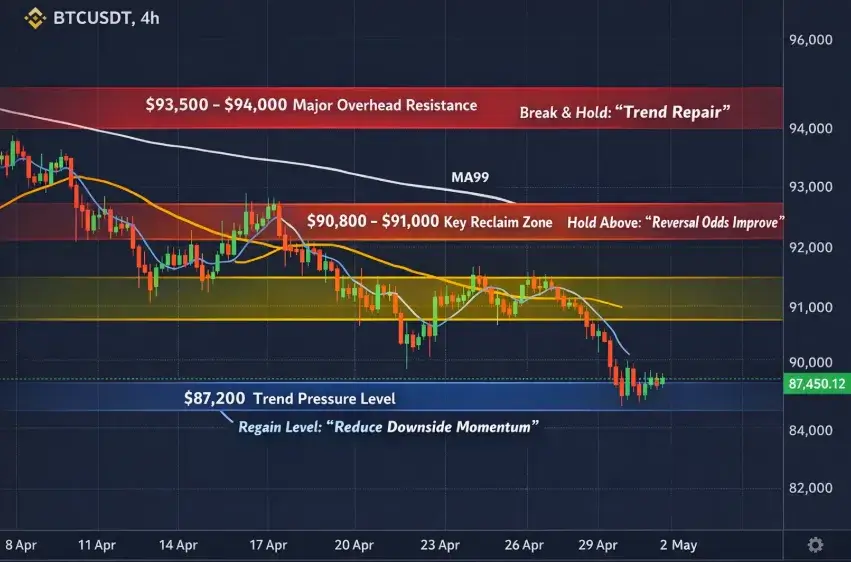
- 87,200 (MA7 region)
- First “trend pressure” line. BTC needs to regain it to reduce immediate downside momentum.
- 90,800 – 91,000 (MA25 region)
- This is the more meaningful reclaim. Holding above this zone improves reversal odds.
- 93,500 – 94,000 (MA99 region)
- Major overhead supply. If BTC breaks above and holds, the market narrative can shift from “bearish rallies” to “trend repair.”
5. Why the Drop Keeps Continuing: The Market Has Not Found a Strong Bid Yet
Your chart shows multiple attempts to stabilize and bounce, but the recoveries look controlled and capped by resistance. That usually means:
- spot demand is not aggressive enough to absorb supply
- sellers are confident selling rallies
- long positions are cautious (or being forced out)
This is also consistent with a market that is deleveraging: open interest can stay high, but the quality of positioning becomes fragile. In that environment, down moves tend to be faster than up moves.
6. Price Outlook: 3 Scenario-Based Forecasts (Not “One Prediction”)
6-1. Scenario: Bearish Continuation (Higher Probability if 80,600 breaks)
Trigger: Daily close below 80,600 with follow-through selling.
What can happen next:
- quick move into the high 70,000s
- volatility spikes, wicks increase
- “dead cat bounces” that fail under 83k–85k
Market logic: breaking a visible swing low often triggers stops + liquidations.

6-2. Range and Stabilization (If 80,600 holds)
Trigger: Price repeatedly defends 80,600–81,000 and reclaims 83,000–85,000.
What can happen next:
- sideways consolidation
- short squeezes on sharp intraday pumps
- better entries for patient buyers, but still choppy
Market logic: strong support defense can absorb sell pressure, but trend remains bearish until MAs are reclaimed.

6-3. Trend Repair Rally (Needs a reclaim of MA25, ideally MA99)
Trigger: Daily close above 90,800–91,000, followed by holding that zone as support.
What can happen next:
- push toward 93,500–94,000
- if MA99 flips to support, a larger recovery becomes possible
Market logic: reclaiming mid/long moving averages changes behavior: sellers back off, dip buyers get confidence, and momentum systems flip.
7. What to Do Instead of Guessing the Bottom
7-1. Use a “Levels-First” plan (remove emotion)
Decide in advance:
- where you will buy
- where you are wrong (stop)
- where you will take profit
Example framework (adjust to your risk tolerance):
- Defensive buy zone: 81,000–80,600
- Invalidation: Daily close below 80,600 (or tighter if you are short-term trading)
- First take-profit zone: 87,200
- Second take-profit zone: 90,800–91,000
7-2. Reduce leverage (or remove it entirely)
In markets like this, leverage is often the hidden reason accounts get damaged. If you must trade derivatives:
- cut position size
- widen liquidation distance
- avoid adding to losers (“martingale” style)
7-3. Scale in, do not all-in
Instead of one entry, consider 3–5 smaller entries. This makes volatility survivable and improves decision quality.
7-4. Watch daily closes, not only intraday noise
Bitcoin frequently produces intraday wicks that look like reversals, then closes weak. For trend changes, daily closes above:
- 87,200
- 90,800
are more meaningful than short-lived spikes.
7-5. Prepare for “bad news” even if none is visible today
Downtrends often continue until a strong catalyst appears. Build a plan that survives:
- sudden 5–10% candles
- weekend liquidity gaps
- liquidation cascades
8. Longer-Term Perspective: “Bull Market” Narratives vs. Bearish Structure
It is possible for Bitcoin to have strong long-term narratives while still being bearish on a daily/weekly structure. Markets move in cycles:
- Narratives create interest
- Liquidity and positioning drive short-term price
- Trend structure determines follow-through
Right now, the daily structure in your chart is signaling trend pressure, not clean accumulation. That does not mean Bitcoin is “finished.” It means timing matters: you either trade the bearish structure carefully or wait for the trend repair signals (reclaims of key MAs).
9. Additional Resources for You
🛡️ Bear Market Execution Kit on Hyukee.com
Don’t just watch the price drop. Learn how to flip your position to Short and profit during downtrends.
Volatility can be dangerous. Master the specific tactics to manage your margin and prevent liquidation today.
Is today’s fall a trend reversal or a buying opportunity? Compare this dip with our 2026 yearly outlook.
💡 Editor’s Note: Maximizing Your Trading Setup
If you’re planning to start trading on Binance, using a partner referral link is the most effective way to reduce long-term costs. You can secure a 20% fee rebate applied directly to your account.
Apply 20% Discount to My Account →10. Practical Summary
- BTC is falling mainly because it is below MA(7), MA(25), and MA(99), which creates heavy overhead resistance.
- Downside moves accelerate due to stop runs and leverage liquidations.
- The most important support on your chart is 80,600–81,000.
- A meaningful recovery likely requires reclaiming 90,800–91,000, and ideally 93,500–94,000.
- Best 대응: levels-based planning, reduced leverage, scaling entries, and using daily closes for confirmation.
11. Q&A (5)
Q1) Why does Bitcoin keep dropping even without major news?
Because price is often driven by liquidity, leverage, and positioning. When stops cluster below support, a small drop can trigger liquidations and momentum selling, creating a self-reinforcing decline.
Q2) What is the most important support level on this chart?
The 80,600–81,000 zone stands out as a key swing low area. If BTC closes below it with follow-through, downside risk increases sharply.
Q3) What must happen to confirm a real rebound?
A stronger rebound is usually confirmed when BTC reclaims and holds above 90,800–91,000 (MA25 area). A larger trend repair improves further if price can also regain the 93,500–94,000 (MA99 area).
Q4) Is it smart to “buy the dip” here?
It can be, but only with a plan. In a downtrend, dip buys work best when you define invalidation (where you’re wrong), use smaller entries, and avoid high leverage.
Q5) How should I manage risk during a volatile downtrend?
Keep position sizes smaller, avoid over-leverage, scale entries, set clear stops, and prioritize daily close signals over intraday noise. Survival and consistency matter more than catching the exact bottom.