
A complete guide to copy trading performance analysis. Learn how to evaluate traders using MDD, Sharpe Ratio, AUM, and ROI to choose safe and reliable copy trading strategies.
Step 1. Complete Guide to Choosing the Right Copy Trading Trader
Copy trading allows investors to automatically follow professional traders without having to analyze markets or place trades manually.
It sounds simple and profitable, but many beginners fail because they focus only on high returns instead of real performance quality.
In reality, selecting a trader based solely on ROI often leads to disappointment and unexpected losses.
This guide explains how to analyze trader performance correctly and how to choose a reliable copy trading account using objective data.
Step 2. Start With the Most Important Metric – MDD
Before checking profit rates, the very first indicator you must review is MDD (Max Drawdown).
2-1. What Is MDD?
MDD represents the largest loss a trading account has experienced from its peak balance.
It shows the worst historical decline and tells you how risky a trader really is.
A trader with extremely high profits but also a very high MDD is usually not suitable for long-term copying.
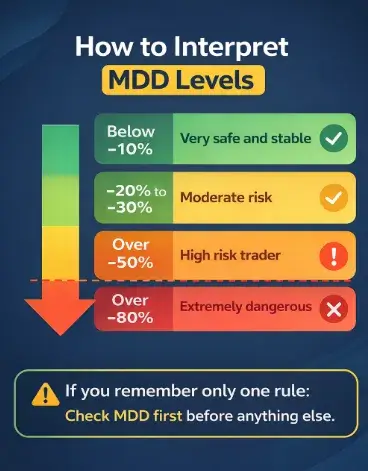
2-2. How to Interpret MDD Levels
- Below -10% → Very safe and stable
- -20% to -30% → Moderate risk
- Over -50% → High risk trader
- Over -80% → Extremely dangerous
If you remember only one rule:
Check MDD first before anything else.
Step 3. Sharpe Ratio – Measuring Profit Quality
Profit alone does not show real performance.
That is why professional investors rely on the Sharpe Ratio.
3-1. Meaning of Sharpe Ratio
Sharpe Ratio measures how consistently a trader earns profit compared to the risk taken.
It answers a simple question:
“How stable and reliable are the returns?”

3-2. Sharpe Ratio Evaluation Guide
- Below 0 → Very poor performance
- Around 0.5 → Unstable
- Above 1 → Good
- Above 2 → Excellent and professional level
A trader with moderate ROI but high Sharpe Ratio is usually much safer than one with huge ROI and low Sharpe Ratio.

Step 4. Understanding AUM (Assets Under Management)
Another essential metric is AUM, which shows how much capital other investors have trusted to a trader.
4-1. Why AUM Matters
- Large AUM → High credibility
- Very small AUM → Possible experimental account
- Growing AUM → Increasing investor confidence
- Decreasing AUM → Warning sign
A trader who manages a steadily growing amount of capital is generally more trustworthy than a new account with unrealistic profits.
Step 5. The Correct Way to View ROI
ROI (Return on Investment) is the most eye-catching number, but it should never be the main decision factor.
5-1. How to Read ROI Properly
- ROI 50% – 300% → Healthy and realistic
- ROI over 1000% → Likely using extreme leverage
- Very fast ROI growth → Often unsustainable
High ROI often comes with very high risk.
Professional copy trading focuses on stability, not gambling-style profits.

Step 6. Analyzing Trading Style – The Hidden Key
Numbers alone are not enough.
You must also understand how a trader actually trades.
6-1. Important Behavioral Factors
- Average position holding time
- Average leverage used
- Win rate vs Risk/Reward ratio
- Frequency of trades
6-2. General tendencies:
- Scalping traders → High volatility and risk
- Swing traders → More suitable for copy trading
For beginners, traders with longer holding periods and lower leverage are safer choices.
Step 7. Ideal Criteria for Beginner Investors
If you are new to copy trading, look for traders that meet these conditions:
- MDD: below -20%
- Sharpe Ratio: above 1.5
- AUM: steadily increasing
- ROI: between 50% and 300%
- Average leverage: under 10x
These standards help filter out risky and unreliable accounts.

Step 8. Trader Types Beginners Should Avoid
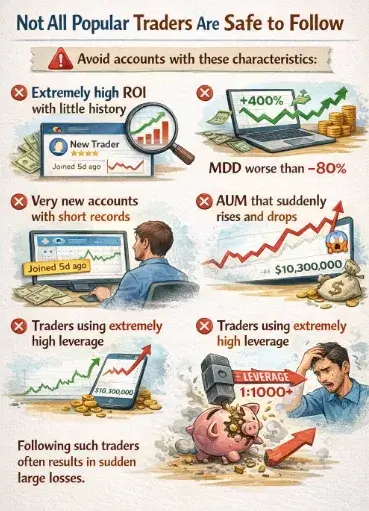
Not all popular traders are safe to follow.
Avoid accounts with these characteristics:
- Extremely high ROI with little history
- MDD worse than -80%
- Very new accounts with short records
- AUM that suddenly rises and drops
- Traders using extremely high leverage
Following such traders often results in sudden large losses.
Step 9. Final Conclusion – The Real Secret of Copy Trading
Successful copy trading is not about chasing the highest profit.
The true rule is simple:
ROI is marketing.
MDD and Sharpe Ratio are real skills.
Choose traders based on stability, risk control, and long-term consistency rather than flashy returns.
That mindset is the foundation of sustainable copy trading success.
Step 10. Frequently Asked Questions (Q&A)
Q1: What is the most important indicator in copy trading?
The most important metric is MDD because it shows real risk and maximum potential loss.
Q2: Is a trader with very high ROI always good?
No. Extremely high ROI often means high leverage and unstable risk management.
Q3: What Sharpe Ratio is considered safe?
Generally, a Sharpe Ratio above 1.5 is considered reliable for copy trading.
Q4: Should I follow a newly created trader account?
It is not recommended. New accounts lack sufficient performance history.
Q5: Which trading style is best for beginners?
Swing traders with low leverage and consistent results are usually the safest choice.
💡 Editor’s Note: Maximizing Your Trading Setup
If you’re planning to start trading on Binance, using a partner referral link is the most effective way to reduce long-term costs. You can secure a 20% fee rebate applied directly to your account.
Apply 20% Discount to My Account →